
Neighborhood Survival
Can neighborhoods become sustainable? A block or a neighborhood is a system that operates within larger and larger systems and finally within Earth system. A sustainable neighborhood is one that can fulfill its needs without diminishing the prospects of future generations of people or the natural world. Can we achieve sustainability or must we abandon cities and build ones that work?
We work with neighbors, houses, lots and institutions and try to work out ways to get from here to sustainability. Come take a virtual tour of what we have done so far. Please use any on the ideas you find here to improve your own neighborhood. Let us know what works for you.
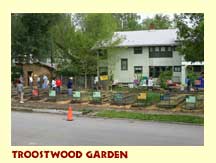 Our main site is Troostwod Garden at 52nd and Paseo. It is a corner lot donated for our use by Rockhurst University. There are 12, 4 X 32 foot raised beds running north to south. We recycled old cedar 1 X 6 pickets for the sides. Running along the north side are a row of fruit trees and a wheelchair accessible bed. Along the south side at the head of each
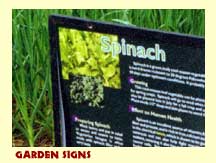
 bed is a sign with vegetable photos, planting info and health effects of that vegetable. At the west end of the
  beds there is an open bed for vine vegetables and then a greenhouse.
========
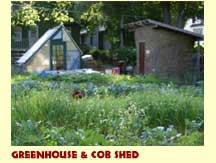
The events of 9/11 helped us see the necessity of creating a structure that was not dependent on anything but the energy from the sun. The greenhouse collects heat from the sun and stores it in water 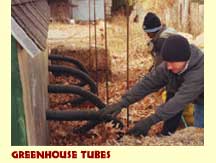 containers for release in the night. Vents are opened automatically by beeswax filled Univent openers that open when they are warm and close upon cooling. We pile leaves for composting against the north wall. The heat from composting is conducted through ducts into the house to help heat the space.
========
The greenhouse promptly filled up with tools, hoses, market 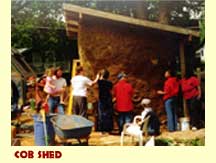 signs and other stuff. This led to us building a cob shed. Cob is a mixture of clay, sand and straw mixed and made into bricks that are laid wet. We could only build about a foot per day because the bricks had to dry to hold their shape. On the west end of the cob shed there is a cob oven where we bake bread and pizza. We start a wood fire and heat up the clay then drag the coals out and bake the bread with the heat stored in the mass of the mud oven.
===========
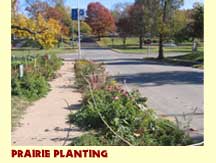 Native plant beds
Along the curb on the south side of the garden are our patches of prairie demonstrating plantings of various sun loving native plants.
==========
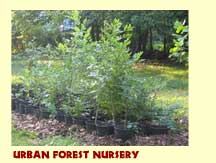 Urban forest nursery
We start tree seedlings in containers, let them grow and then in a couple of years make them available to people to purchase at the market. We hope to help replenish the trees of the city that are lost to storm and disease. One neighbor collected seeds from his favorite maple tree and sprouted them. After one season he brought them over and we transplanted them into containers. He made a donation to help with their care until we sell or give them away.
===========
North lot addition
In the '05 season we added a second lot to the site. We raised some fine tomatoes, green beans and peppers there. It is a little shadier than the first lot so some crops won’t do well here.
===========
CIVIC ENGAGEMENT - 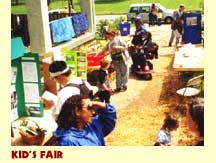 building good neighborhood community is central to our mission. You can study in private and learn how to live sustainably but you have to come together with others to make life work. Our Saturday Market is our face on the world. It is the place where we encourage others to do their part in healing the environment. We do this by example, conversation, workshops and other events
===========
Saturday Market
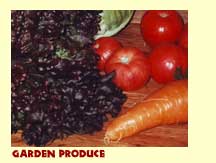 On Saturdays we have a market where we sell vegetables. It is held in the Wright’s driveway next to the garden. We provide naturally grown vegetables to neighbors and others. The program kids also sell the vegetables learning the fundamentals of business.
========
Solar cooking
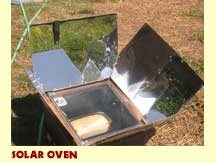 We demonstrate the power of the sun to bake brownies, bread and other foods during market and other events.
========
Gardens need year round care so anytime is a good time to join us "planting seeds."
|
|
|